

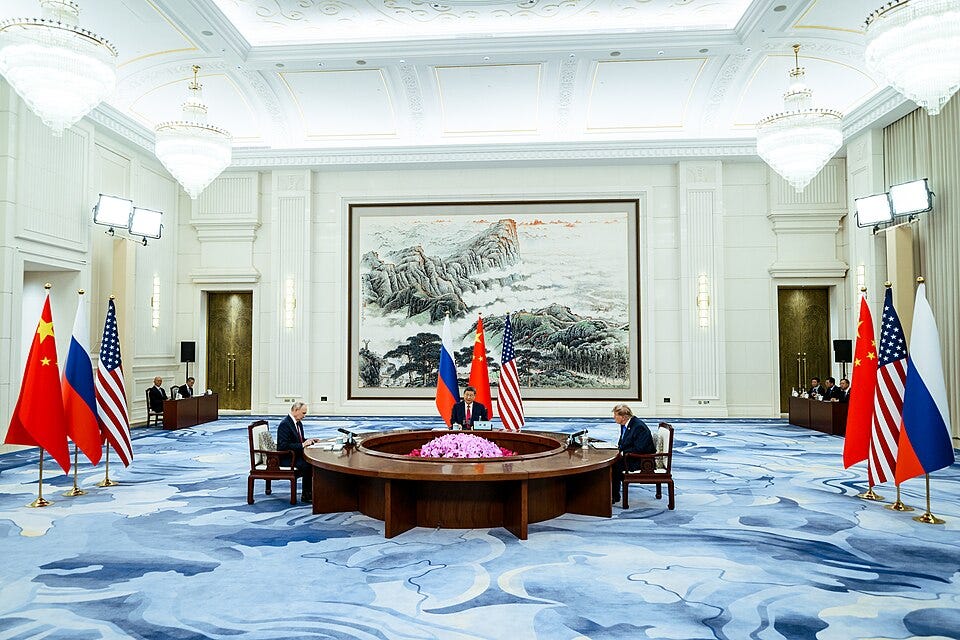
Twenty-one APEC economies gathered in Shenzhen last week, representing over a third of the world’s population and nearly two-thirds of global GDP. Yet the summit’s most consequential meeting included just three leaders: Xi Jinping, Donald Trump and Vladimir Putin.
Beijing framed the November 19 meeting around “safeguarding world peace and enabling strategic stability in major-country relations,” citing their shared status as permanent members of the UN Security Council. France and the United Kingdom hold the exact same status; neither was invited.
Following the talks, the three powers issued a joint declaration calling for UN reform and state immunity from the International Criminal Court. In 1945, Roosevelt, Churchill and Stalin settled questions of Chinese territory at Yalta without a Chinese delegate in the room. Eighty years later, the logic has not changed—only the host.
When great powers negotiate global rules among themselves, middle powers absorb the fallout without a voice at the table.
In Shenzhen, the three leaders pledged dialogue to reduce nuclear risks and affirmed that a nuclear war must never be fought, yet stopped short of launching arms-control negotiations. Six months earlier, at the Non-Proliferation Treaty review conference of roughly 190 states, the five recognized nuclear powers pushed to remove language requiring concrete disarmament.
Putin and Trump discussed the war for about 40 minutes without announcing results, and their joint declaration omitted Ukraine entirely. Kyiv was absent, while European leaders were left to coordinate separately in Berlin.
The other 18 APEC economies were in the room where it happened but not part of the conversation. This dynamic reflects a broader shift from multilateral rule-making to transactional great-power bargaining. When Washington, Beijing and Moscow treat global institutions as instruments to be reshaped or bypassed among themselves, formal membership in forums like APEC offers middle powers visibility but no influence.
Avoiding this trap requires moving beyond rhetorical defenses of the international order toward concrete action. In practice, middle powers can coordinate trade and regulatory standards across blocs such as CPTPP and the European Union, build leverage over critical minerals and supply chains, and reinforce disarmament and legal norms even when permanent Security Council members step back.
Eight decades after Yalta, the lesson for middle powers remains the same. Rules-based institutions will not defend themselves. Middle powers must build coalitions capable of exercising real, collective leverage—or accept terms written by others behind closed doors.